
Europe’s solar industry is entering a new phase. Alongside new PV capacity, attention is increasingly turning to existing solar plants and a growing question for owners and operators: how can aging PV assets be modernized to improve performance and energy output?
For many plants, revamping or repowering can provide that second life. By upgrading aging technology, operators can improve performance while continuing to make use of valuable existing infrastructure. Reliable monitoring then becomes essential for understanding whether those improvements are delivering the expected results.
What are PV revamping and repowering?
Revamping typically involves replacing or upgrading selected equipment to restore or improve an existing PV plant. Repowering can go further by introducing newer technology to increase the capability of the asset and potentially extend its economic lifetime.
While modules and inverters are often central to these projects, modernization can also involve cabling, mounting systems, monitoring and control systems, and other plant infrastructure.
The opportunity is to determine what existing infrastructure can continue to deliver value and where newer technology can improve performance.
What can modernization deliver?
The Gleisdreieck solar power plant in Bitterfeld provides a practical example.
Around 8.5 MWp across 13 inverter sections was modernized within five weeks, with 13,788 new modules installed while the plant remained in operation.
Initial monitoring data showed:
- Performance Ratio, Phase 1: 75% to 91%
- Performance Ratio, Phase 2: 68% to 87%
- Power per W/m² of irradiation: +23%
- Are existing irradiance measurements appropriate for the modernized plant?
- Can environmental and soiling effects be distinguished from equipment-related underperformance?
- Is there sufficient data to demonstrate whether modernization delivered the expected improvement?
- Will the monitoring system support performance assessment during the plant’s next phase of operation?
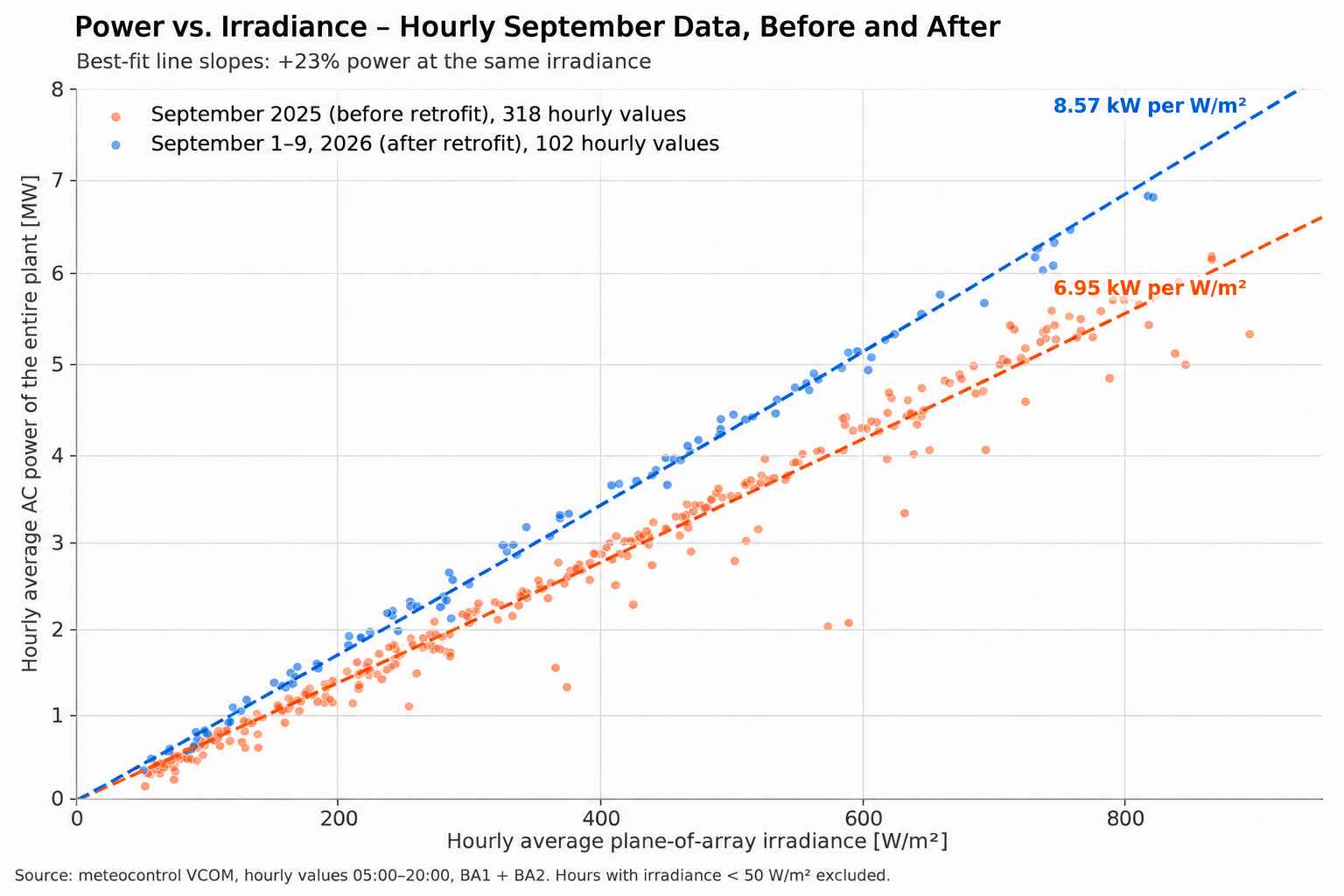
A comparison of two days with similar solar radiation showed daily energy yield increasing from 40.1 to 49.5 MWh, approximately 23% more energy yield with only 3% more solar radiation.
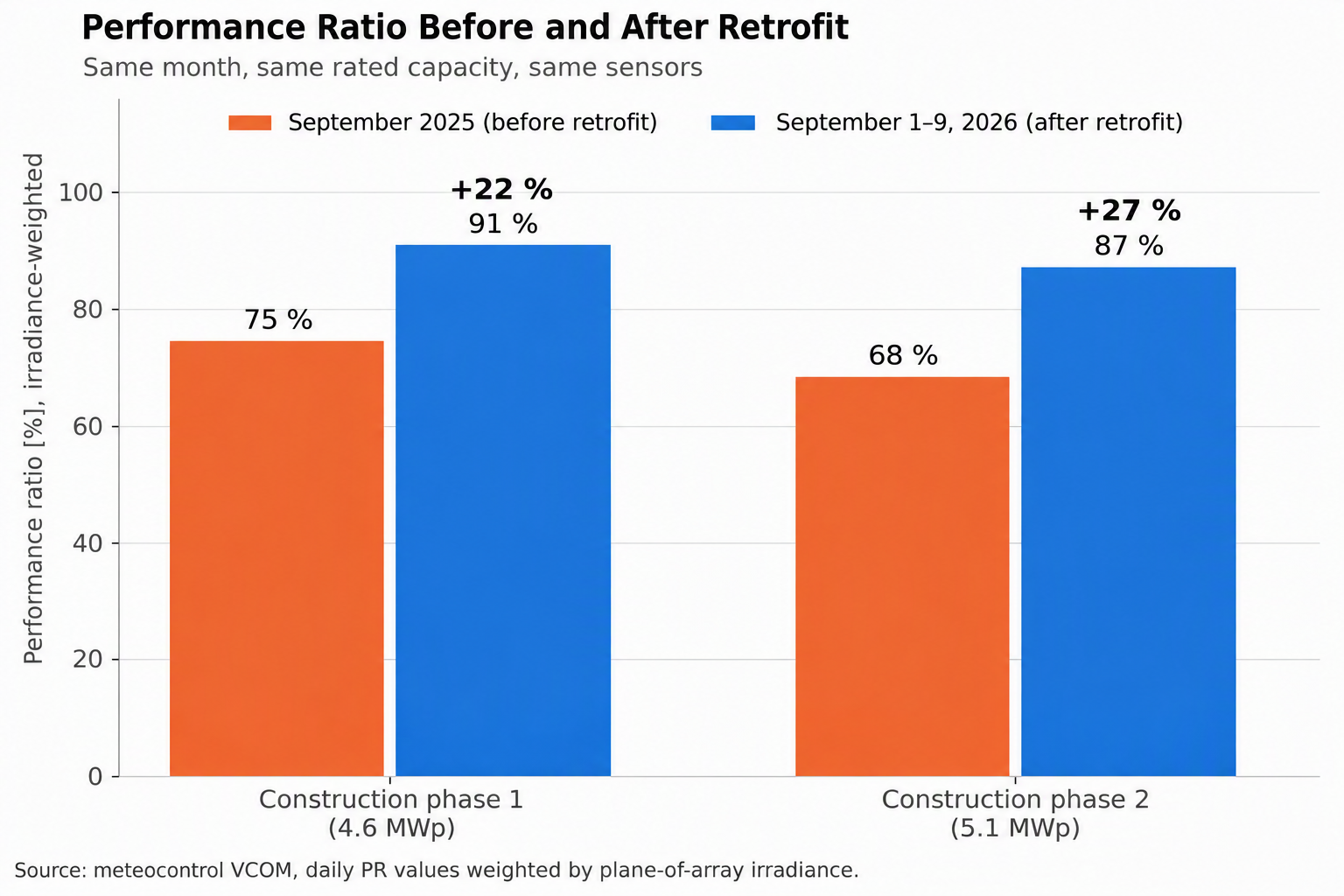
The results demonstrate the potential of revamping. They also highlight why reliable measurement matters: improved output is meaningful, but environmental data provides the context needed to understand and quantify that improvement.
Modernizing the plant means understanding its performance
Energy production tells operators how much electricity a plant generates. It does not, by itself, explain why the plant performs the way it does.
Solar irradiance provides the reference for understanding how much solar energy is available to the PV system. Measurements such as module temperature, weather conditions and soiling add further context.
This becomes particularly important after revamping. If energy production increases, operators need reliable measurements to understand whether that improvement comes from the modernized plant or differences in environmental conditions.
IEC 61724-1:2021 defines terminology, equipment and methods for photovoltaic system performance monitoring and analysis, including requirements and guidance for parameters such as irradiance and soiling.
The objective is to move beyond simply asking, ‘How much energy are we producing?’ to understanding, ‘Is the plant performing as expected under the conditions available to it?’
Monitoring technology has evolved too
Just as modules and inverters have advanced, so has PV performance monitoring.
Accurate irradiance measurement provides a reference for assessing the available solar resource. Soiling measurements can help distinguish contamination-related losses from other causes of underperformance, while module-level measurements can provide additional insight into performance and degradation.
Kipp & Zonen provides solar irradiance measurement solutions for PV performance monitoring, while the Atonometrics portfolio adds capabilities for PV soiling and module-level performance assessment.
For example, the RDE300i enables in-situ IV curve measurements of PV modules while they remain installed in an operating plant, providing insight into module performance and degradation under field conditions.
Make monitoring part of the revamping conversation
When modernizing an existing PV plant, owners and operators should consider:
The objective is not simply to add more sensors. It is to ensure the right measurements are available to support informed decisions.
Giving a solar plant a second life
Revamping and repowering can give aging PV plants a second life by introducing newer technology to improve performance and make better use of existing infrastructure.
The Bitterfeld example demonstrates the potential: approximately 23% more daily energy yield with only 3% more solar radiation. Measurement is what puts that improvement into context.
Giving a solar plant a second life is ultimately about getting better performance and more value from an existing asset. Reliable monitoring helps operators understand and demonstrate whether that modernization is delivering what it should.
Source: Performance data and project figures for the Gleisdreieck solar power plant revamping project in Bitterfeld are provided by Enovos Renewables O&M GmbH and based on monitoring data shared following the project.